The Louvre at Night, Wing by Wing
The short answer
In a two-hour evening you can see the best of all three wings if you plan. Spend the most time in Denon, where the Salle des États and the Daru staircase hold the museum's two most visited works. Give Sully the Greek sculpture and the old fortress below it, and keep half an hour for Richelieu's Assyrian courtyard and the Second Empire rooms.
The Louvre covers about 73,000 square metres, with some 35,000 works on display. Nobody sees it in an evening, and the late openings give you three hours at most. Knowing which wing holds what is how you make them count, whether you go alone or with one of the Louvre guided tours. Room numbers below are the museum's own. Rooms close from week to week, so check what to expect inside for the current list before you go.
Three wings, one evening
| Wing and level | What is there | Time to allow |
|---|---|---|
| Denon, Level 1 | The Salle des États (room 711) and the Daru staircase (room 703) | 45 minutes |
| Sully, Level 0 | Greek sculpture and the Salle des Caryatides (room 348) | 30 minutes |
| Sully, Level -1 | The medieval fortress and the Crypt of the Sphinx (room 338) | 20 minutes |
| Sully, Level 1 | Egyptian art, and the Seated Scribe (room 635) | 15 minutes |
| Richelieu, Levels 0 and 1 | The Cour Khorsabad (room 229) and the Second Empire rooms (rooms 544-545) | 30 minutes |
The hall under the Pyramid opens straight into all three wings. You can walk between them inside, but it is a long way from Denon's paintings to Richelieu's courtyards. The full list of works and rooms is on what to see at the Louvre at night.
Denon, Level 1: the largest room in the palace
The Salle des États is the largest room in the Louvre, and since 1966 it has held the Mona Lisa. Leonardo painted it on a panel of poplar wood, which has warped over the centuries, so it hangs in a glass case that keeps the temperature and humidity steady. King François I bought it from Leonardo in 1518. In 2019 the walls were repainted a deep midnight blue.
The crowd here never thins completely, even on a late night. So turn round. The other wall holds The Wedding Feast at Cana by Veronese, the biggest painting in the Louvre, with some 130 figures at a Venetian banquet. Most visitors spend their minutes facing the glass case and never look at it.
The Daru staircase and the winged goddess
At the top of the Daru staircase stands the Winged Victory of Samothrace, a goddess about to land on the prow of a ship. It was carved from marble from Paros, probably around 190 BC, and found on the Greek island of Samothrace in 1863 by Charles Champoiseau, in some 110 fragments. It has stood on this landing since 1883.
No head and no arms were ever found. Later digs turned up only the right hand, and it is here, in a small showcase on the landing: a 27-centimetre hand with its palm turned up. Almost everyone walks past it.
Useful tip. Photos are allowed in the permanent collections, but without flash, lighting or a selfie stick. The staircase is at its best from the foot of the steps, where you see the statue against the light from above.
Sully: Greek sculpture and the old fortress
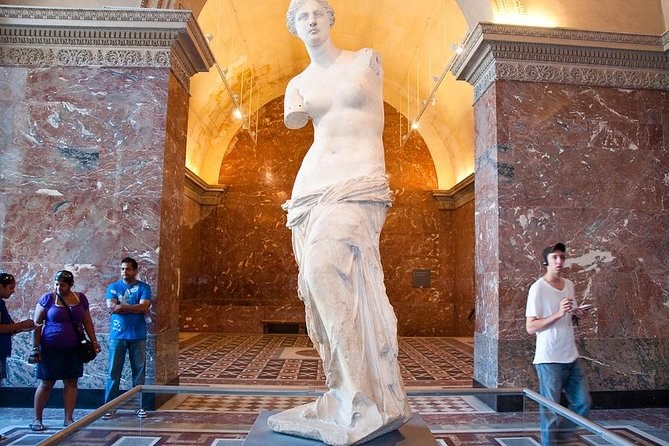
The Venus de Milo stands almost alone in the last of a long run of Greek rooms, set off by red marble from the time of Napoleon I. It was found on the island of Melos in 1820 and reached the Louvre in March 1821. Restoring the missing arms was proposed and then dropped, for fear of changing the work.
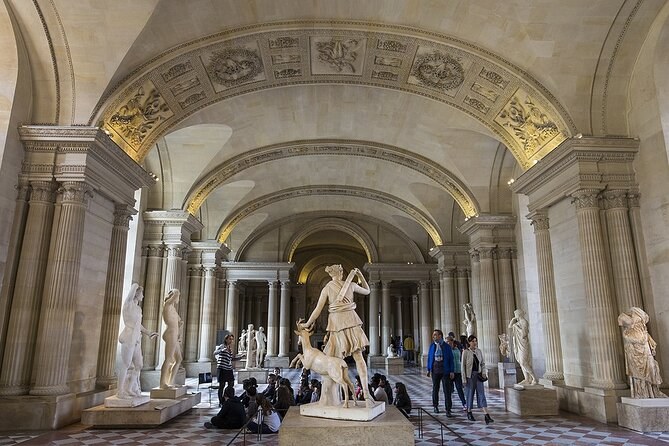
Next door is the Salle des Caryatides, the Renaissance ballroom where Molière first played before Louis XIV. Four sculpted women carved by Jean Goujon in 1550 hold up the musicians' gallery. Below, on Level -1, you walk along the medieval moat of the fortress the Louvre once was. From there the Crypt of the Sphinx opens the Egyptian galleries: over 6,000 works spanning almost 5,000 years. Upstairs, the Seated Scribe's eyes are inlaid with rock crystal. Walk round the case and they seem to follow you.
Richelieu: Assyria and the Second Empire
The Cour Khorsabad, on Level 0, rebuilds a gateway of the palace of King Sargon II. Its winged bulls with human heads were each carved from a single block of alabaster weighing about 28 tonnes. The site was dug in 1843 by Paul Émile Botta, and the finds made the Louvre the world's first Assyrian museum.
Upstairs, the Napoleon III apartments are the gilded state rooms of a minister of the Second Empire, open to the public since 1993. Travellers on two different evenings wrote that they wished they had been shown these rooms, so if you have half an hour left, spend it here.
Five things most visitors walk past
- The Victory's right hand, in its showcase on the Daru landing.
- The Wedding Feast at Cana, on the wall behind the crowd in the Salle des États.
- The musicians' gallery on Goujon's four caryatids.
- The Seated Scribe's rock-crystal eyes, which follow you round the case.
- The inverted pyramid in the Carrousel entrance: 84 diamond-shaped panes and 28 triangles.
The Carrousel entrance, at 99 rue de Rivoli, is open until closing on a late night and is marked on the entrances and meeting points map.
Where the crowd gathers, and a two-hour route
On a late night the Salle des États is busy until it clears. Last entry is at 8pm (the hours for each day are on the visitor guide), so nobody new arrives after that, and the rooms start clearing at 8:30pm. A route that starts quietly and keeps the busiest room for the middle works well:
- Sully, Level -1: the medieval moat and the Sphinx.
- Sully, Level 0: the Salle des Caryatides and the Greek rooms.
- Denon, Level 1: the Daru staircase, then the Salle des États.
- Richelieu: the Second Empire rooms, then down to the Assyrian courtyard.
Travellers who went with a guide say the same thing: the size is what defeats a first visit. If you want someone to hold the thread, compare three private hours from 6pm, which cover all three wings, with two private hours on a Napoleon thread that end in Richelieu and leave you inside. The difference between the two late nights is set out in Wednesday or Friday, and the week's exhibitions, some in these wings, are on the exhibitions page. Every guided evening is compared on the night tour options page.
Want a guide to hold the thread?
Private tour Louvre By night
Three private hours from 6:00pm at the foot of the arch facing the Pyramid, through the Sully, Denon and Richelieu wings and back out as the museum closes. Two travellers minimum; the timed ticket is in the fare.
From $336 per person For a party of two; the per-person fare falls as your group grows
Check Availability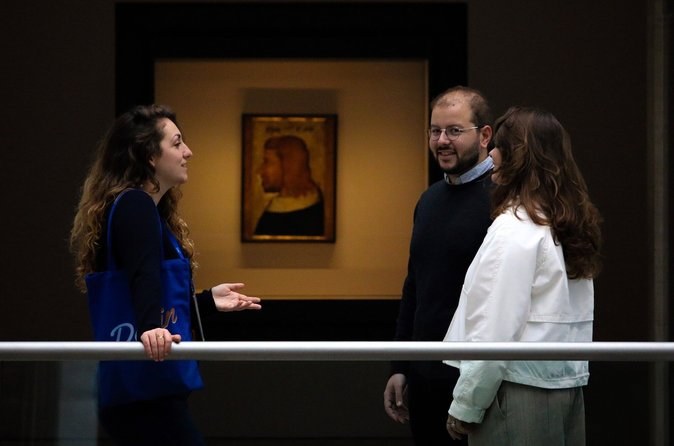
Louvre Late Opening Private Tour – Fewer Crowds & Highlights
Two private hours from the horse statue by the Pyramid, on a Napoleon thread from Denon to Richelieu. Your guide leaves you inside, free to stay on until the rooms clear.
From $346 per person For a party of two; the per-person fare falls as your group grows
Check Availability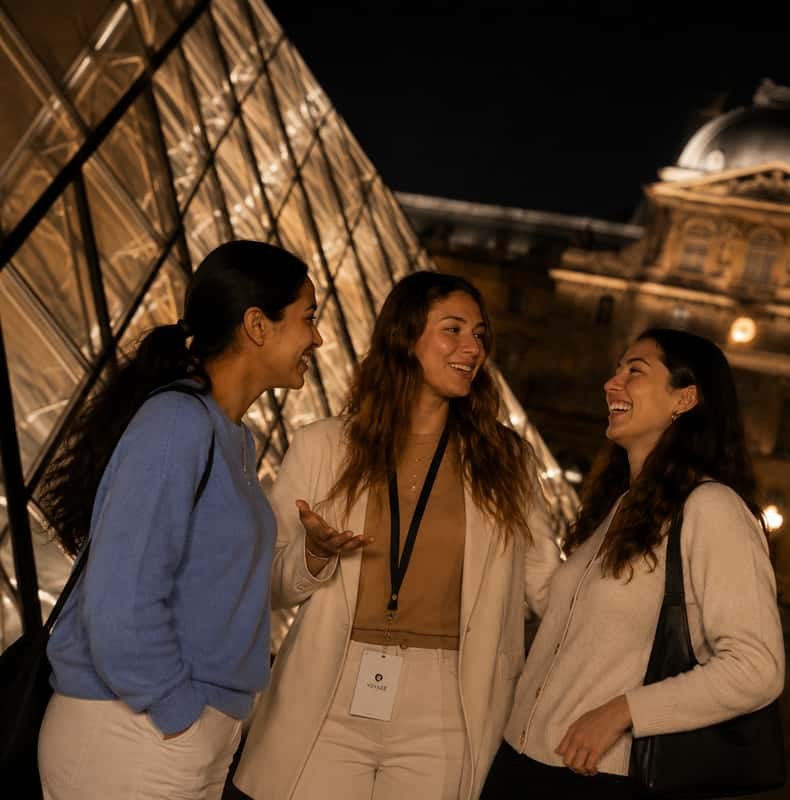
Night at the Louvre: Guided Museum Tour | Max 6-Guests
Two hours with a licensed guide and five other guests at most, from the metro exit on rue de Rivoli. The museum ticket and every booking fee are in the fare.
From $175 per person
Check AvailabilityNext: Choose the wing you care most about, then the evening that reaches it with time to spare. Every evening fare sits side by side on Louvre Tours.